Conference report:
Geopolitical risks and economic (in)security at the 5th Kiel-CEPR Conference on Geoeconomics

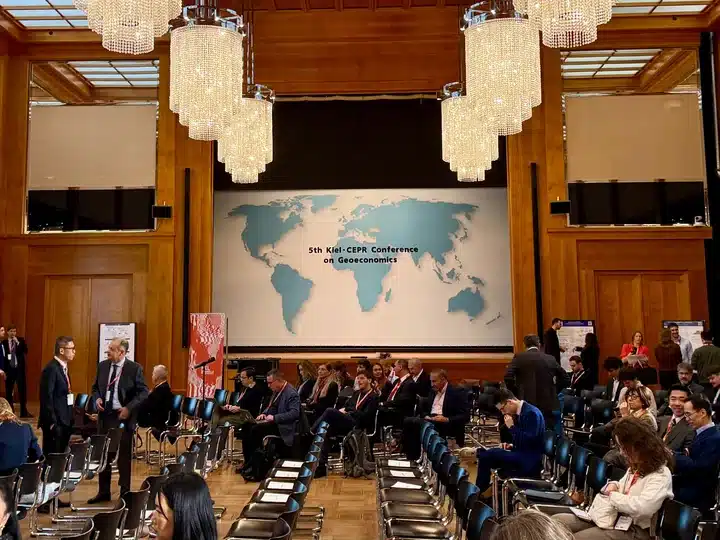
On November 3 and 4, 2026, I represented Standard Error at the 5th Kiel–CEPR Conference on Geoeconomics, hosted at the German Federal Foreign Office in Berlin. This was my first visit to Berlin and the third year Standard Error had been invited to this invitation-only event. Founder and lead editor Samantha Eyler-Driscoll attended in 2024, and I attended last year’s edition at Sciences Po in Paris.
The conference brought together researchers studying how geopolitical tensions interact with the economy and policymakers confronting those interactions directly. The program covered trade wars, sanctions, defense, and the international monetary system, among other important topics.
German Federal Minister for Foreign Affairs Johann Wadephul opened the conference with a keynote and joined Kiel Institute president Moritz Schularick and Susanne Wiegand for a panel moderated by Deutsche Welle’s Sarah Kelly. Wadephul emphasized that there exists a demand among middle powers to build partnerships with Europe. Schularick pointed to the division between EU trade policy and national security responsibilities at a time where trade dependencies can be weaponized, while Wiegand highlighted the costs of adapting the economy to geopolitical fragmentation.
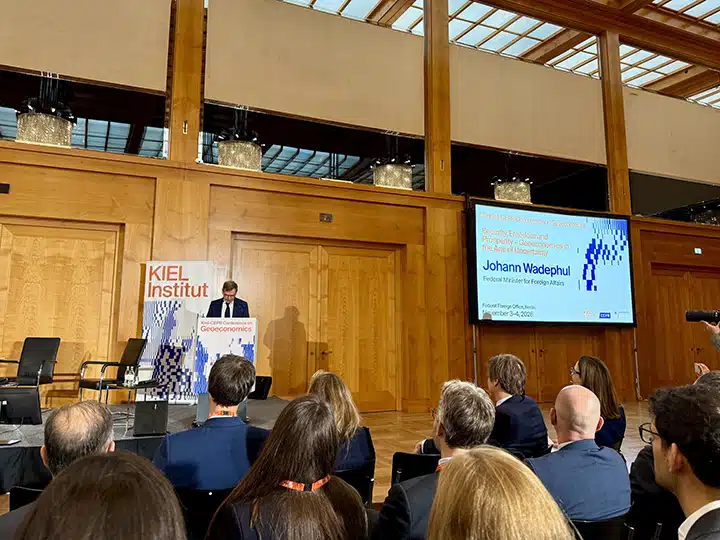
Johann Wadephul
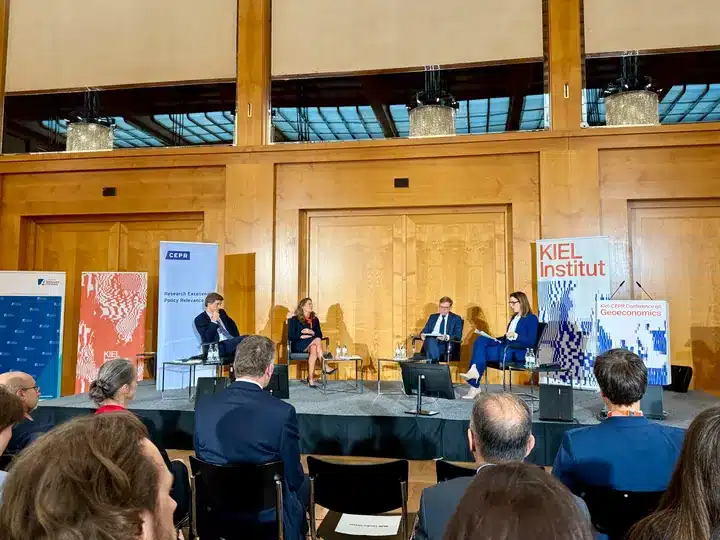
Moritz Schularick, Susanne Wiegand, Johann Wadephul and Sarah Kelly
Their exchange on defense spending was especially interesting. Schularick questioned the military capabilities Europe gets from its fragmented, and sometimes inefficient, procurement, and Wiegand discussed various policies designed to develop cooperation between European defense firms.
The Trade Wars session began with Hillary Stein (Boston Fed) presenting research on how tariffs affect firms. The paper finds that the 2025 US tariffs reduced sales and variable costs, without corresponding effects on margins or investment. Exposure extends beyond a firm’s own imports to the costs faced by its suppliers. Meredith Crowley (Cambridge and CEPR) then theoretically examined how US tariffs change competition among exporters. Firms’ decisions to leave markets account for much of a trade war’s welfare losses. Her paper also shows that dependent neighbors are especially vulnerable to tariff threats, while coordinated retaliation increases the costs to the US.
Carmen Reinhart questioned the expectation that AI-driven growth would resolve high debt burdens. She sees debt-financed overinvestment in AI as a more immediate financial risk than an advanced-economy fiscal crisis.
Carmen Reinhart (Harvard and CEPR) gave a keynote on debt, bubbles, and wars. She questioned the expectation that AI-driven growth would resolve high debt burdens. Her comparison with nineteenth-century railway investment was particularly memorable: Railways transformed the economy, but overinvestment still brought bankruptcies and financial crisis. A technology’s success does not guarantee that the investments surrounding it will pay off. Reinhart saw debt-financed overinvestment in AI as a more immediate financial risk than an advanced-economy fiscal crisis.
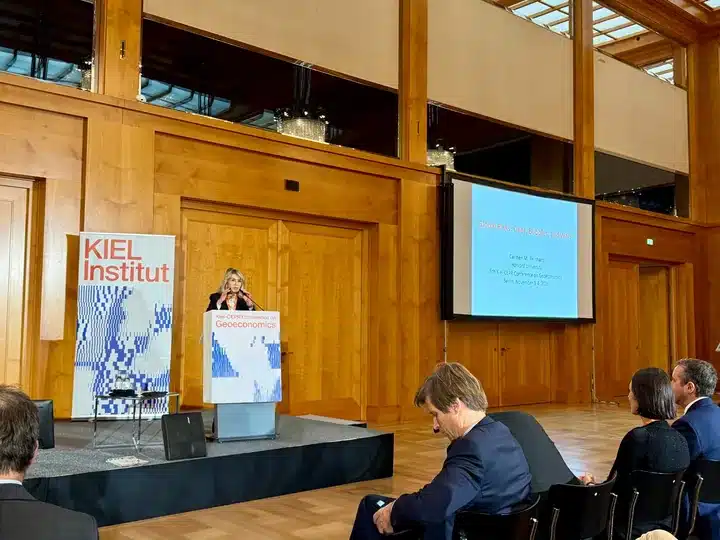
Carmen Reinhart
After the keynote, four people received this year’s Excellence Awards and briefly introduced their research, a format I enjoyed last year and enjoyed once again this year. Thomas Drechsel (Johns Hopkins and CEPR) described how he uses unconventional and noneconomic data to better understand macroeconomics. Isabela Manelici (LSE and CEPR) discussed how multinationals are complex organizations that can be leveraged to foster economic development. Alexey Makarin (MIT Sloan and CEPR) spoke about the economics of war, the economics of media, and how geopolitical shocks spread through the economy. Marco Tabellini (HBS and CEPR) outlined his work on the economic and political consequences of migration.
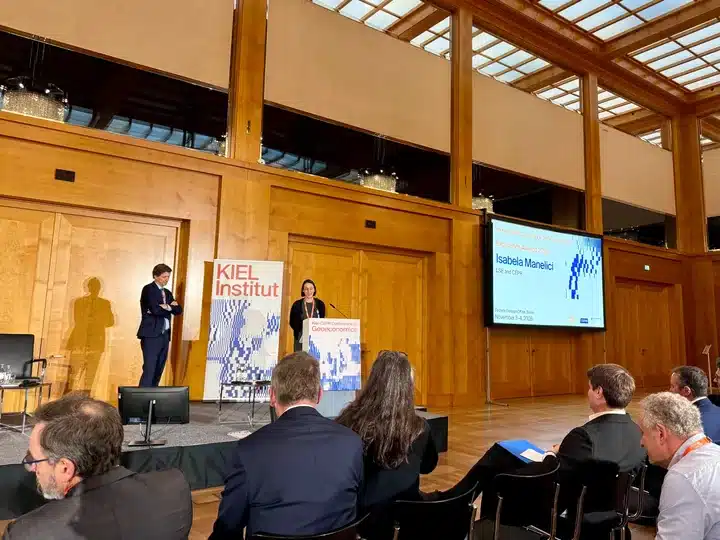
Isabela Manelici
Later that afternoon, Andrea Presbitero (IMF and CEPR) presented research asking whether China had expanded aid following US retrenchment. The authors find no evidence of increased Chinese aid even if the data cannot show whether China has increased aid toward countries it sees as strategically important.
The Finance and Conflicts session featured Lionel Fontagné (Paris School of Economics) on who benefits from rising defense budgets in NATO. Military procurement remains strongly domestic, even among allies, but US suppliers also benefit from other NATO countries’ buildup. Greater European integration can change the distribution of production, with higher budgets potentially offsetting production losses. Nicola Limodio (Bocconi and CEPR) gave an excellent presentation on financial sanctions against Pakistani terrorist organizations. The paper shows that targeted groups adapt through new charities, even if the targeted groups also tend to fragment due to internal power dynamics. Sanctions also change the geography of violence, with attacks increasing in Pakistan while declining in the US and Western Europe. The groups’ capacity to reorganize makes the effects of sanctions more complicated than simply restricting their access to finance.
The second day began with a session about Networks and Geoeconomics. Stephen Redding (Stanford and CEPR) presented a theoretical paper explaining geopolitical alignment as a trade-off between a country’s own interests and its willingness to align with connected countries. As a network enthusiast, I’m always on board for a good economics of networks model — and this paper delivered.
Arvind Krishnamurthy (Stanford) followed with an illuminating keynote on dollar erosion. He examined what losing reserve currency status would mean for the US and where the first signs would appear. The recent data are consistent with an erosion of the dollar. But a shift to another dominant currency would also require a credible challenger, and the evidence shows that none exists today.
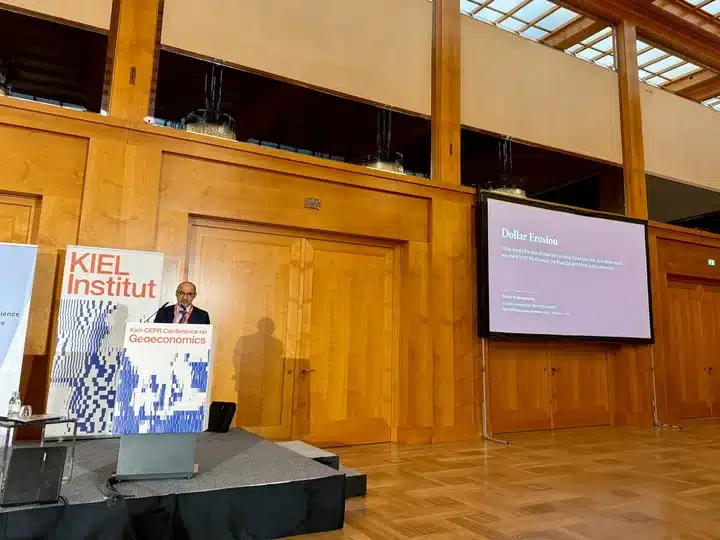
Arvind Krishnamurthy
In the Geopolitical Risks session, Wei Xiang (Michigan) presented research showing that deteriorating political alignment has offset a substantial share of the trade gains from tariff liberalization, starting from 2007. Simon Fuchs (Atlanta Fed) examined empirically and with a general equilibrium model when dependence on foreign shipping becomes vulnerability. His paper studies disruptions and blockade scenarios, including Taiwan, and shows that exposure doesn’t necessarily translate into vulnerability.
Pierre-Olivier Gourinchas argued that a posthegemonic world, where global public goods and safe assets are not provided by a single hegemon but by a collective, may still be possible if cooperation emerges.
The Bernhard Harms Prize went to former IMF chief economist Pierre-Olivier Gourinchas (Berkeley, CEPR) with a laudation by ECB chief economist and CEPR fellow Philip Lane. Gourinchas’s lecture was about the international monetary system in a fragmenting world. Cooperation among middle powers could limit the damage of fragmentation, but such cooperation would require deep integration and credible collective commitments. The use of finance as a geopolitical weapon could encourage countries to insure themselves against one another, further weakening cooperation. A posthegemonic world, where global public goods and safe assets are not provided by a single hegemon but by a collective, could still be possible if cooperation emerges.
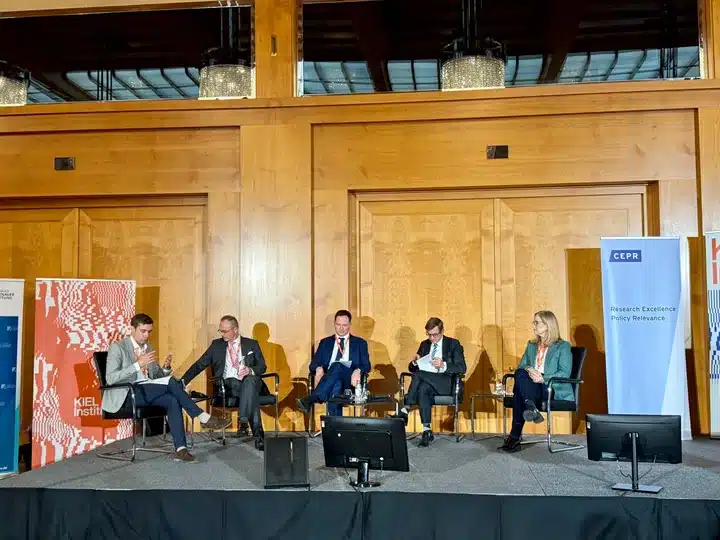
Steven Beardsley, Kristupas Vaitiekūnas, Thomas Steffen, Benjamin Gallezot and Meredith Crowley
The final panel brought together France’s strategic minerals delegate Benjamin Gallezot, German economy ministry state secretary Thomas Steffen, Lithuanian vice foreign minister Kristupas Vaitiekūnas, and economist Meredith Crowley (Princeton and CEPR). Moderated by Deutsche Welle’s Steven Beardsley, it addressed how public policies can help secure critical raw materials in Europe. Such policies involve deep collaboration between governments and the private sector—an example of such collaboration being tracing supply chains from critical raw materials to identify risks and bottlenecks. Reducing exposure to these risks isn’t costless. As a result, reducing exposure means deciding which risks justify the costs of diversifying supplies, at both national and European levels, and which risks can remain risks.
Once again, I very much enjoyed the conference, especially in a city as fantastic as Berlin. The defense and network presentations were highlights for me, while the other presentations, the panels, and the keynotes opened up important questions further from my own work in organizational (and labor, if I’m being honest) economics. I look forward to attending next year’s conference.